If you’re still counting on those passive lead-acid battery systems, your high availability goals remain elusive. The current trend is to move to an integrated, active architecture; that is, to combine high-rate Nickel-Zinc batteries with intelligent battery management systems (BMS).
The core advantage of this modern solution is the 3C discharge capability of the Nickel-Zinc technology. Within the same footprint, its power density is significantly higher than the traditional VRLA (valve-regulated lead-acid battery). More importantly, it significantly mitigates the risk of “thermal runaway” that is a headache in some lithium battery solutions. By monitoring SOH, SOC, and cell internal resistance 24/7, we can switch directly from the passive mode of “repair” to “predictive maintenance”. This technical synergy not only ensures that the UPS can withstand the moment of mains power failure, but also optimizes the total cost of ownership and energy efficiency.
For a long time, VRLA (valve-regulated lead-acid) batteries have been the mainstream choice for backup power in data centers. Although modern battery management systems (BMS) are capable of real-time monitoring, the inherent electrochemical characteristics of lead-acid batteries—such as their nonlinear internal resistance behavior and susceptibility to thermal runaway—necessarily shift the BMS focus toward “disaster prevention and monitoring.” To mitigate the fire risk posed by thermal runaway and sudden cell failure, operations and maintenance personnel must regularly monitor internal resistance, negative-electrode temperature, and float charging current. This mode is essentially a “high-intensity passive defense”.
In contrast, high-rate nickel–zinc batteries address the risk of thermal runaway at the fundamental electrochemical level. Thanks to its intrinsically safe, non-flammable, and non-explosive nature, the BMS’s functions can be decoupled from the heavy burden of “disaster prevention” and shifted toward higher-level “fine-grained asset management.” Within a nickel–zinc battery architecture, the BMS does not need to continuously monitor for fire hazards. Instead, by acquiring more stable voltage profiles and charge–discharge characteristics, it can achieve extremely high-accuracy predictions of SOC (state of charge) and SOH (state of health).
This transformation has evolved the backup power system from passive, “zero-incident” maintenance to data-driven, precision predictive operations and maintenance, completely eliminating the operational anxiety traditionally associated with batteries due to their unpredictable failure modes.
The core of a reliable backup power supply is whether it can deliver high power bursts in an instant. Gerchamp’s Nickel-Zinc batteries are specifically designed for this high-rate discharge scenario.
3C discharge capacity: Different from ordinary batteries, Nickel-Zinc batteries support 3C discharge rate. This means that they can provide huge power support in a very small volume. This performance is vital for the millisecond-level response required during a mains failure. It ensures a seamless transition to backup power, eliminating the risk of even a momentary outage, which could result in catastrophic data loss or hardware damage before generators stabilize.
Ultra-high power density: The power density of Nickel-Zinc batteries is much higher than that of lead-acid batteries. The floor space of the battery room can be significantly reduced, and the saved “white area” space will be filled with a few more server cabinets, which are pure profit.
Natural safety: The biggest concern with lithium solutions is the risk of fire. The Nickel-Zinc chemical system itself is non-combustible, and there is no chain reaction thermal risk. For those computer rooms that prioritize safety above all else, this is definitely the most stable high-performance choice at present.
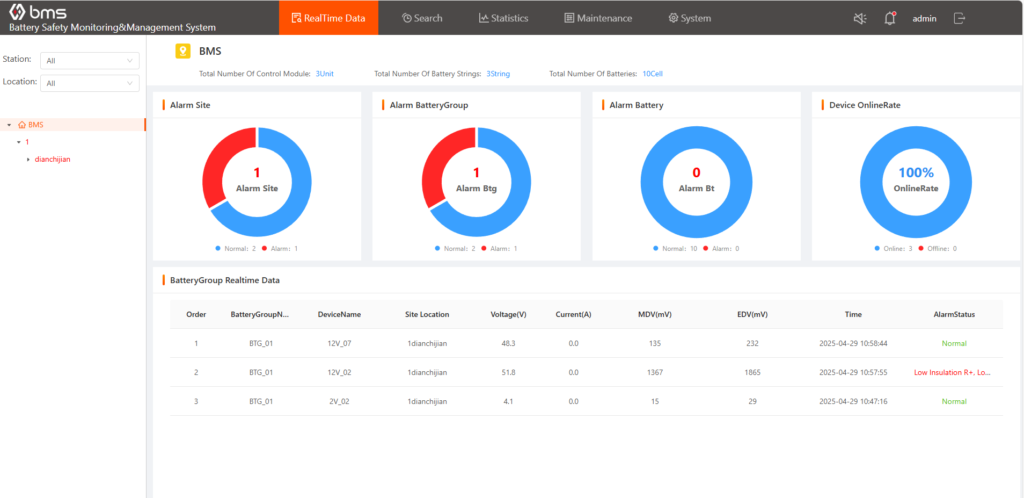
Whether a backup power supply scheme is safe often depends on the weakest battery. By integrating a smart UPS battery management system (BMS), the energy storage system is no longer a “black box” and becomes a transparent and controllable asset.
Through 24/7 real-time monitoring of parameters such as negative terminal temperature and float current, the system provides granular data:
State of Charge (SOC): By managing precise float current levels, the system ensures the energy reservoir is maintained in a constant state of readiness for immediate discharge.
State of Health (SOH): By tracking the aging process of the battery, engineers can create a replacement plan before failure occurs.
Internal resistance monitoring: The internal resistance change of a single battery is the most accurate indicator to predict failure. Once the internal resistance suddenly spikes, the system will immediately trigger a warning to remind you that there is a weakness in the chain.
This granular monitoring can greatly reduce the risk of downtime, and because there is no longer a need to blindly replace batteries in groups, the operation and maintenance costs are also reduced.
Investing in high-performance solutions is not only about peace of mind but also about calculating the Return on Investment (ROI).
Lower total cost of ownership (TCO): Although upgrading Nickel-Zinc batteries and BMS initially looks a little more expensive, considering their extended service life compared to traditional lead-acid batteries, combined with significant savings in maintenance labor and replacement frequency, the total cost of ownership is optimized over the entire lifecycle.
Improving power usage effectiveness (PUE): Nickel-Zinc batteries are small in size and have lower cooling requirements, which helps to improve the PUE score of the computer room and is very suitable for the energy saving and environmental protection goals of the current ultra-large-scale facilities.
Flexibility of edge computing: Edge rooms are usually narrow and fire-fighting requirements are strict. Gerchamp’s compact combination of Nickel-Zinc and BMS is simply tailor-made for this kind of scene.
In the business of zero fault tolerance in data center operation and maintenance, “close enough” is definitely not an option for backup power. The synergy of Gerchamp’s Nickel-Zinc battery and intelligent BMS provides a level of protection that lead-acid or traditional lithium batteries can hardly match.
By prioritizing high power density, thermal safety, and predictive analytics, we can stand behind our commitment on the line in the face of the world’s most demanding computing workloads.
Author : Caleb
I am the BMS Project Manager at Gerchamp. With nine years of experience in the electrical and battery industries, I specialize in critical data center power solutions. I have led teams in executing large-scale BMS installations for major domestic and international clients, including Alibaba, ensuring the safe integration and precise management of advanced battery power systems.
Apply a demo of Gerchamp’s Cloud Platform
Apply a demo of Gerchamp’s Cloud Platform
 Gerchamp