How To Charge Ni Zn Batteries

How To Charge Ni Zn Batteries If you want to charge a nickel zinc battery, you must reconfigure the UPS rectifier or DC power supply system, strictly implement the charging strategy of constant current and constant voltage (CC-CV), and accurately lock the target voltage of a single battery at 15.20V. The charging cycle usually starts from the constant current phase. If it is for standard balance maintenance, I recommend setting it to 0.3C (about 11.4A); but if you encounter a scenario where you need to quickly restore capacity, you can also push it to the maximum 1C(38A) Fast charge rate.

What Is Battery Monitoring System

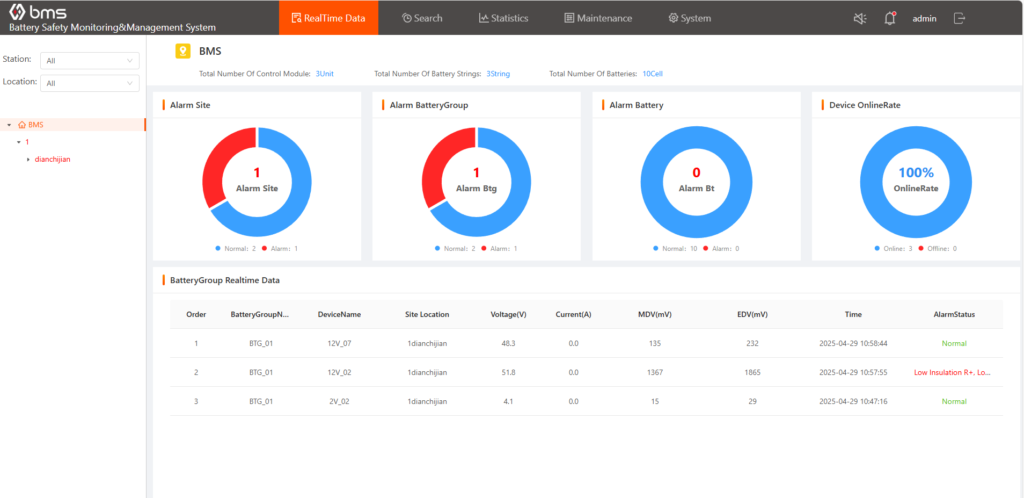
What Is Battery Monitoring System In the context of lead-acid energy storage systems, a battery monitoring system (BMS) is essentially an automated electronic platform specifically designed to track the health and operational integrity of stationary battery packs in real time. It measures a series of key parameters, including the cell voltage, group current, ambient and negative terminal temperature, and the most important indicator-the internal resistance (Ohmic value). By continuously monitoring the float current and accurately identifying deviations in internal resistance (which is usually a leading indicator of battery sulfation or electrolyte drying up), the system can predict failures before they

Battery Management System Working Principle

Battery Management System Working Principle The core function of BMS is actually a hierarchical closed-loop control system. The ultimate goal of our architecture design is always to maximize the cycle life of lithium iron phosphate (LiFePO4) or ternary lithium battery clusters, and to ensure absolute safety. At first, the battery management unit (BMU) was responsible for “capturing” real-time analog data through a high-precision analog front end (AFE)—specifically single cell voltage and temperature. At the same time, the main controller monitors the total current of the battery pack through a high-precision sensor. We will use ampere-hour integration combined with Kalman filtering

What is Battery Management System

What is Battery Management System Simply put, BMS is a dedicated electronic control unit, you can think of it as the intelligent “brain” of a rechargeable battery pack. In my daily work, this system is most commonly used in lithium applications in energy storage systems (ESS). Its core responsibility is very clear: don’t let the battery “out of the loop”-that is, you must prevent the battery from operating outside the safety limit. The BMS continuously monitors voltage, current, and temperature etc. like an eagle-eye to prevent failures such as overcharge or thermal runaway that can lead to catastrophic consequences. Of